China's Agricultural Industry
Chinese government is actively putting more funds to strongly develop the following aspects:
◎ Farm and cropland construction with high standard
◎ Farm irrigation construction
◎ Agricultural circulation basic establishment
◎ Bio-environment construction
◎ Mechanization of farming
◎ AI+ agricultural Technology and services
◎ The allowance for purchasing premium seeds, agricultural instruments and machineries and other agricultural materials
China has about 0.9 billion farmers, so it is very important for Chinese government keeping the stable economic development, and there will be wide business opportunities in the sector of Chinese agricultural industry. The latest system of land innovation that promulgated by Chinese government will permit those farmers to sell the privileges of land managements, which will help to establish much more modern farms of intensive cultivation and mechanization. In this case, China will need more agricultural instruments and machineries relating with cultivation, irrigation, maintain and so on.
The Agriculture of Zhejiang
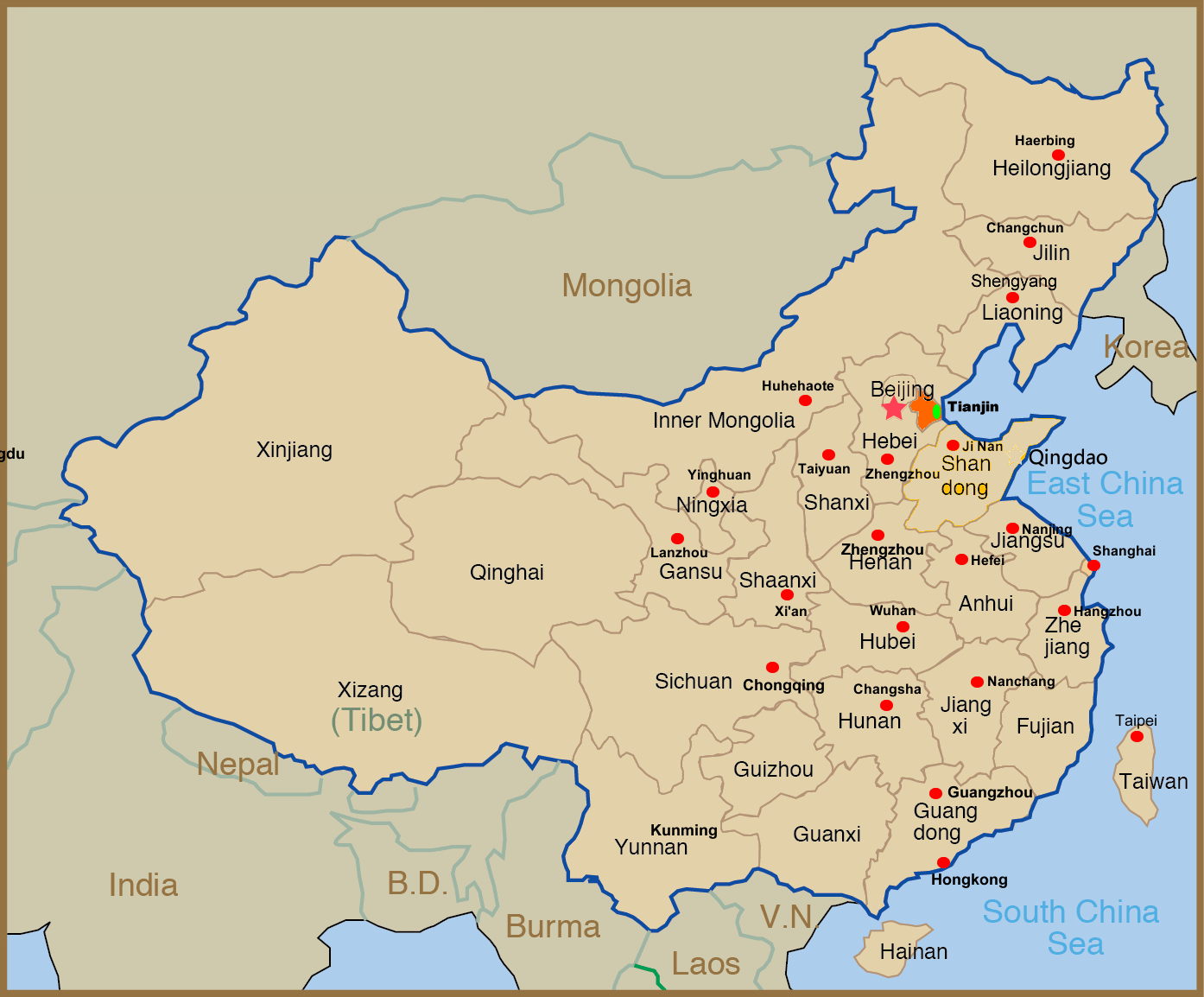
Hangzhou is the capital of Zhejiang provice and Zhejiang Province has been built into a strong province of efficient ecological agriculture, with a total output value of 418.11 billion RMB yuan (an increase of 3.7%) in 2024, achieving a "nine consecutive increases" in grain production (6.502 million tons), a contribution rate of 69.15% in agricultural scientific and technological progress, and a comprehensive mechanization rate of 83.09%, accelerating the transformation towards new quality productivity.
Core data and scale
-Total output value: The total output value of agriculture, forestry, animal husbandry and fishery in 2024 is 418.11 billion RMB yuan, of which the fishery industry has grown significantly (with a cumulative increase of over 100%), and the animal husbandry industry has stopped falling and rebounded.
-Food security: The sowing area is 15.705 million mu, with a total output of 6.502 million tons, and a continuous increase in production for nine years; There are 6.243 million live pigs in stock.
-Business efficiency: The per capita disposable income of rural residents is 42786 RMB yuan (growth rate 6.1%), and the urban-rural income ratio has been reduced to 1.83; The total income of village collective economy is 84.5 billion RMB yuan.
-Industrial chain: 126 complete industrial chains with an output value exceeding 1 billion RMB yuan (total output of 321.6 billion RMB yuan) have been established, and 693 leading enterprises at or above the provincial level have been cultivated.
Technology and mechanization level
-Double Strong Drive: Implement the "Science and Technology Strong Agriculture, Machinery Strong Agriculture" action, build 205 modern agricultural service centers, and provide services covering the entire chain of grain and oil crops.
-Revitalization of Seed Industry: Over 85% of broccoli varieties are domestically produced, breaking the monopoly of imports; Platforms such as "AI Breeders" have reduced the breeding cycle by half.
-Equipment upgrade: suitable for the cluster development of agricultural machinery in hilly and mountainous areas, with 8173 unmanned aerial vehicles for plant protection; The mechanization of rice production ranks among the top in the south, and the key links in tea gardens have basically been mechanized.
-Smart Agriculture: The first smart agriculture leading area in China, with 33 recognized "Future Farms" and 417 digital agriculture factories, resulting in a 3-5 fold increase in per mu efficiency.
Industrial structure and characteristic layout
-Leading industries: Vegetable production ranks first (about 19.92 million tons), annual output of aquatic products is about 6 million tons (seawater products account for more than 76%), and distinctive advantages such as fruits, tea, and silkworm cocoons are obvious.
-Regional distribution: The total output value of Ningbo, Taizhou, and Hangzhou exceeds 50 billion RMB yuan; Jiaxing and Shaoxing mainly produce grain, Hangzhou and Ningbo mainly produce vegetables, Taizhou and Ningbo mainly produce fruits, and Zhoushan and Taizhou mainly produce aquatic products.
-Brand empowerment: Promote the full chain development of "local specialty richness", such as Xianju Yangmei's full industry chain output value exceeding 4.8 billion yuan, forming a processing cultural tourism integration model from "fresh in one season" to "sweet in all seasons".
Service system and green transformation
-Social services: Build a "5-kilometer agricultural service circle" and provide "field nanny" full custody services from seedling cultivation to sales, reducing comprehensive costs by about 15%.
-Green development: The comprehensive utilization rate of straw has reached 97.8%, the use of fertilizers and pesticides continues to decrease, ecological models such as rice duck symbiosis are promoted, and soil organic matter has significantly improved.
-Digital empowerment: The "Zhejiang Agricultural Code" has been assigned 690 million times, and the Internet of Things and big data are widely used for pest monitoring, precision irrigation, and traceability management.
Challenges and Trends
-Resource constraints: Fragmentation of arable land and aging of labor force still exist, and mechanization in hilly and mountainous areas still requires breakthroughs in specialized equipment.
-Future goal: By 2027, the contribution rate of agricultural scientific and technological progress is planned to reach 72%, and the mechanization rate is 84%, with a focus on developing low altitude economic scenarios and deep AI applications.
-Reform direction: Deepen the "Ten Million Project", promote the revitalization of rural housing and the reform of separation of powers, cultivate over 100000 rural entrepreneurs, and strengthen the support of county-level industries for enriching the people.
